FloatMe: Fast Cash Advance App
- 4.5
- Rating
- 1.00M
- Installs
- Free
- Price

 Analysis by App-foxy
I came to FloatMe as a finance app for a very specific moment: the uncomfortable stretch between an ordinary expense and the next payday. Its promise is simple—request a cash advance without interest or a credit check—but the useful question is not whether that sounds convenient. The useful question is whether this kind of short-term help fits the way you manage money.
After looking at how the app is positioned and how it fits into everyday budgeting, my view is fairly balanced. FloatMe can be a practical emergency tool when a small timing problem would otherwise create a larger one. It is much less suitable as a regular way to cover a recurring gap in income. That distinction matters more here than the attractive simplicity of the first screen.
How FloatMe fits into real financial life
FloatMe is a free finance app from the developer FloatMe, aimed at people who need help before payday. It is available for Everyone and runs on Android devices using at least Android 7.0. The app has reached over a million installs, with an average rating of 4.5 from around 70 thousand ratings and roughly 18 thousand written reviews. Those figures suggest that the basic idea has found a substantial audience, although popularity alone should never replace checking whether the service suits your own cash flow.
You May Also Like

 Blood Strike: 2.5 Anniversary
Blood Strike’s Loadouts Turn Every Drop Into a Tactical Gamble
A close look at Blood Strike’s custom loadouts: how fast access to signature weapons reshapes its battle royale rhythm, rewards preparation, and narrows the gap between fights.

 Pandora - Music & Podcasts
Pandora’s Music Is Easy to Start, but Harder to Recover
Pandora’s strength is its low-effort path from a seed to a station. Its weak spot is how much confidence it asks you to place in connection, setup, and quiet recovery.

 8 Ball Pool
 Is Built on Rivalries, Rematches, and Routine
A close look at the rivalries, rematches, shared routines, and unanswered safety questions that turn a quick pool match into a persistent mobile community.

 Samsung Music
’s Quiet Strength Is Playing What You Already Own
Its reach comes less from spectacle than from dependable access to a personal library. That simplicity is both the app’s strongest retention engine and its ceiling.

 AccuWeather: Weather Radar
AccuWeather Review: A Quick, Clear Forecast for Everyday Decisions
For everyday plans, the best forecast is the one you can understand quickly. AccuWeather makes rain timing, radar, and local conditions easy to act on, with a few trade-offs.

 Hill Climb Racing
Why Hill Climb Racing Still Turns Crashes Into One More Run
A tiny car, a bumpy hill and one more upgrade: Hill Climb Racing keeps resurfacing because its simple chaos makes every near-miss feel personal.
More From Our News Desk



The central appeal is the possibility of getting a cash advance without interest or a credit check. That makes the app different from a conventional personal loan application, where approval may depend on credit history and the total cost can grow through interest. It also makes FloatMe different from a normal budgeting app: a budget can show you that money is tight, but it cannot by itself solve a bill that arrives before your income does.
I would think of it as a bridge, not as extra income. If a payment is due on Friday and your paycheck arrives Monday, a small advance may help you avoid an overdraft, a late payment, or an awkward delay. If the same shortage appears every pay cycle, repeatedly using a bridge only hides the underlying problem. In that situation, changing bill dates, reducing fixed expenses, or finding a more sustainable income solution is more important than another advance.
The current experience is built around urgency
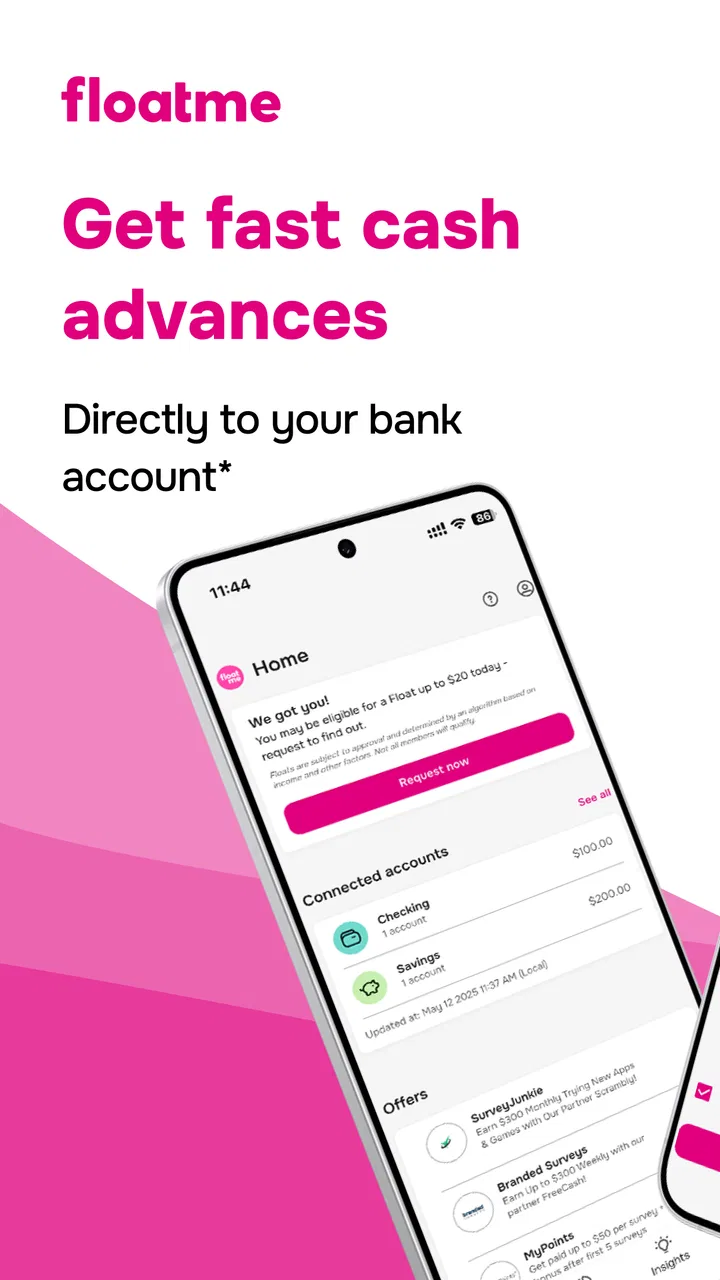
People usually open an app like this when they are already under pressure, so clarity matters. FloatMe’s strongest conceptual advantage is that it focuses on one immediate task rather than presenting a full investment dashboard, credit marketplace, or complicated debt-management course. That narrow purpose can make sense when you need to decide quickly whether a short-term option is available.
Still, “quick” should not be interpreted as “automatic.” A cash advance app still requires careful attention to eligibility, repayment timing, connected financial information, and any conditions shown during the request process. I would not start an application while rushing out the door or while distracted by an urgent bill. Read each screen, confirm the repayment date, and make sure the amount you request will not leave the next paycheck short.
One useful habit is to treat the advance as already spent from your next payday. If you receive help for a grocery purchase today, mentally remove that amount from the money you expect later. This simple adjustment prevents a common mistake: solving today’s shortage while accidentally creating another one a week later. FloatMe can support that kind of planning, but it cannot make the repayment impact disappear.
Where the no-interest model helps—and where it does not
The absence of interest is an important difference from many borrowing options. With a traditional loan, the cost is often tied to the amount borrowed and the time it takes to repay. FloatMe’s stated appeal is more straightforward: access to a cash advance without interest or a credit check. For someone who needs a modest amount because of timing, that may be less expensive and less intimidating than applying for a conventional loan.
However, “no interest” is not the same as “no consequences.” Users should still look closely at the complete request and repayment details presented in the app. A service may be free to download while particular delivery choices, optional services, eligibility conditions, or account requirements affect the overall experience. I would never approve a request based only on a headline promise; I would review the final terms shown before confirming anything.
The lack of a credit check can also be both helpful and limiting. It may give people an option when a traditional lender would not be appropriate, but it does not mean the advance is suitable for every financial situation. Credit history is only one part of affordability. Your income schedule, existing bills, and ability to absorb the next repayment matter just as much.
A realistic payday-gap example
Imagine that your car needs an unexpected repair late in the week, and without the repair you cannot get to work. Your paycheck is due shortly afterward, but the mechanic needs payment first. In that narrow situation, FloatMe may be worth considering because the expense protects your ability to earn the next paycheck. Before requesting anything, I would compare the amount needed with the amount that will remain after rent, utilities, food, and other fixed commitments are covered.
Now change the example. Suppose the repair is only one part of a pattern in which every paycheck is consumed before the next one arrives. The same advance might solve the immediate crisis, but repayment could make the following week harder. Here, a conversation with a bill provider, a revised payment date, or a longer-term budgeting plan may be a better choice. The app is most defensible when the problem is temporary timing rather than a permanent shortfall.
What the app’s evolution means for users
The current version is 8.8.0, and FloatMe was released on October 4, 2018. That combination tells me the product has had time to develop beyond its original launch, while the version number confirms that users are working with a maintained current release rather than the first iteration. I would interpret that as evidence of ongoing product evolution, not as a guarantee that every part of the experience will feel perfect on every phone.
For existing users, a current version can matter in practical ways. Updating may improve compatibility with newer Android devices, refine account flows, or address problems that were present in older builds. It is sensible to use the latest available release instead of relying on an old installation, especially for a finance app where sign-in, account connections, and transaction-related screens need to work reliably.
At the same time, a newer version does not automatically change the basic financial trade-off. Version 8.8.0 may represent continued refinement, but it does not turn a cash advance into a budgeting solution or remove the need to check repayment details. I would separate the technical question—does the app run properly?—from the financial question—is borrowing this money sensible for me?
That separation is one of the most important lessons for returning users. An update can make navigation smoother without changing eligibility, timing, or the amount you can responsibly repay. If you have used FloatMe before, do not assume that a familiar-looking request should be approved on autopilot. Recheck the amount, the expected repayment, and the effect on your next pay cycle every time.
Small workflow choices that make a big difference
My first practical tip is to calculate the shortage before opening the request screen. Write down the exact bill or purchase, subtract any money already available, and request only the remaining amount if the app makes that amount available to you. Asking for a rounded figure because it feels safer can leave you repaying more than necessary.
My second tip is to use FloatMe after reviewing your calendar, not before. Look at the next paycheck, rent or mortgage, subscriptions, transportation costs, and any scheduled automatic payments. A cash advance that looks manageable in isolation can become risky when several withdrawals land together. The app can address a timing gap, but your calendar reveals whether the gap is actually isolated.
My third tip is to keep a written record of the request and repayment plan. I would note the amount, the expected date, and the reason for borrowing. This is not busywork. After several stressful weeks, it is easy to forget which expense an advance covered or to confuse an expected repayment with available spending money. A simple note can prevent accidental double-counting.
A fourth useful approach is to reserve the app for expenses with a clear payoff path. A necessary transportation cost before a confirmed paycheck is easier to evaluate than discretionary shopping, entertainment, or an open-ended spending spree. If you cannot explain exactly how and when the advance will be repaid, that is a strong signal to pause rather than proceed.
How FloatMe compares with familiar alternatives
A normal bank overdraft may be more convenient if your account already provides a clearly understood buffer, but overdraft terms can be expensive or confusing. FloatMe’s appeal is that it is designed specifically for a payday gap and does not rely on a traditional credit check. The better choice depends on the exact cost, timing, and conditions attached to each option—not simply on which one opens faster.
A credit card can be more flexible for a purchase that must be paid today, particularly if you already understand its repayment terms. The downside is that carrying a balance can create interest charges and a longer debt cycle. FloatMe may be preferable for a short, defined gap, while a card may be more practical for a purchase that cannot be repaid with the next paycheck. Neither option is automatically safer.
A personal loan is usually a poor match for a very small, urgent shortage because the application and repayment structure can be heavier than the problem itself. On the other hand, a personal loan or credit-union product may be more appropriate when the need is larger, predictable, and impossible to repay immediately. FloatMe is not a substitute for structured borrowing when you need longer-term financing.
Finally, a budgeting app or a conversation with an employer may be better when the issue is recurring. Budgeting tools help identify patterns, while an employer may offer a pay schedule or workplace option that fits your situation. FloatMe is strongest as a targeted response to a temporary mismatch between money arriving and money being needed.
Remaining friction and reasons to be cautious
The biggest limitation is built into the product category: an advance moves money forward, but it does not increase your total income. That can make the next payday feel smaller. Anyone living with a persistent shortfall should be particularly careful, because repeated use can turn occasional relief into a cycle that is difficult to break.
Another point of friction is the need to understand the complete experience rather than relying on the app’s short description. Eligibility, account setup, delivery timing, repayment arrangements, and any options displayed during the process all deserve attention. I would also make sure the phone is secure, the account credentials are protected, and notifications are enabled if they help you keep track of important activity.
FloatMe should not be your first choice for a medical emergency, a large repair, tuition, or any expense that will take several months to repay. Those situations call for a solution designed around the size and duration of the need. Likewise, people who prefer never to connect financial information to a third-party finance service may decide that the convenience is not worth the trade-off.
The Everyone age rating makes the app broadly accessible in store terms, but age suitability is not the same as financial suitability. A person can be old enough to use a finance app and still be unprepared for the consequences of borrowing against future income. I would judge readiness by the ability to understand the repayment plan and maintain essential expenses afterward.
What I would watch before relying on it
I would watch how clearly the app presents the complete cost and timing of each request. The most useful finance products make the important information easy to find before confirmation. If you have to hunt for repayment details or interpret vague wording, slow down and ask whether the convenience is worth the uncertainty.
I would also watch my own frequency of use. One request connected to a specific, temporary event is very different from opening the app every payday. If advances become part of your normal budget, the warning sign is not necessarily a technical problem with FloatMe; it is evidence that your income and expenses need a different solution.
For existing users, I would keep the app updated and pay attention to changes in the request flow after updates. The current release may improve the experience, but responsible use still depends on reviewing each transaction. Product evolution can reduce friction; it cannot replace personal judgment.
My final recommendation is therefore conditional. I would suggest FloatMe to someone facing a small, short-lived payday gap who has a confirmed repayment path and wants to explore an option without interest or a credit check. I would not recommend it to someone trying to fund regular living costs, manage a large expense, or avoid confronting an ongoing budget deficit.
As a free finance app with a focused purpose, FloatMe is most useful when treated as an emergency bridge rather than a second paycheck. Its current release and established user base make it worth considering, but the responsible decision happens before the request button: check the next payday, protect essential bills, read the terms shown in the app, and borrow only what you can repay without creating the next crisis.
FAQs for FloatMe: Fast Cash Advance App
01What is FloatMe and how does it work?
FloatMe is a financial app designed to help users avoid overdraft fees by providing small cash advances. Once you sign up and connect your bank account, the app analyzes your spending patterns and offers advances up to $50. The advance is automatically repaid when you receive your next paycheck, ensuring a seamless user experience.
02Is FloatMe safe to use with my bank information?
Yes, FloatMe employs strict security measures to safeguard your personal and financial information. The app uses bank-level encryption and does not store your login credentials. Additionally, it is designed to comply with financial regulations, ensuring that your data remains confidential and secure at all times.
03Are there any fees associated with using FloatMe?
FloatMe charges a subscription fee of $1.99 per month for access to its services. This fee covers unlimited cash advances and access to the app's budgeting tools. Unlike traditional payday loans, FloatMe does not charge any interest on the advances, making it a more affordable option for managing short-term cash needs.
04How quickly can I receive a cash advance from FloatMe?
Cash advances from FloatMe are typically transferred to your bank account within a few hours, but it may take up to three business days depending on your bank's processing times. The app's quick transfer times make it a convenient option for users who need immediate financial assistance.
05What are the eligibility requirements for using FloatMe?
To use FloatMe, you must be at least 18 years old and have a bank account with a regular income. The app requires users to connect their bank account for transaction monitoring. While there is no credit check, maintaining a consistent income flow is essential for eligibility and receiving cash advances.
Pros
- Instant cash advances up to $50.
- No credit check required.
- Low monthly subscription fee.
- User-friendly interface.
- Quick and easy setup process.
Cons
- Advances limited to $50 max.
- Subscription required for use.
- No Android version available.
- Limited financial management tools.
- No overdraft protection features.

FloatMe: Fast Cash Advance App
Gallery